Genoa . . . Venice . . . Bristol . . . New World!! It's time to throw fake "Discoverer" Portuguese "Christopher Columbus" overboard into the sea of oblivion where he rightly belongs!! The Fall of Constantinople to the Muslim Turks in 1453 blocked the great maritime power of Venice from the Eastern Mediterranean and the Asian spice trade. As a result, they set their eyes on a westward passage to the Orient. John Cabot used maps that the Venetian looted from Constantinople in 1202.
On June 24, 1494, John Cabot landed in the New World and planted the banners of England, Ireland and France and the lion of St. Mark of Venice. According to the laws of discovery in force at that time, when a country discovered an island, that entire island belonged to that country. Since the New World was ONE CONTINENT or landmass from north to south, John Cabot's claim of first discovery extends to the entire New World. Christopher Columbus can claim the islands of Santo Domingo, Cuba and the Caribbean Islands—but that is all. John Cabot (Giovanni Caboto) was born in Genoa, Italy, in 1450.New World Discoverer John Cabot was born in Genoa, Italy, in 1450. We believe that he was born in this very house that is now falsely called the birthplace of Columbus.
Only the Genoese and Venetians fought side by side with the Eastern Romans to defend their beloved city against the Muslim Turks. Venice was the adopted homeland of the family of John CabotJohn Cabot's family moved to Venice when he was 11 years old. Venice was the sailing superpower of the Middle Ages. She was also known as "queen of the seas." Any non-Venetian who wanted to learn oceangoing navigation went to Venice. Venice had a very special relationship with Constantinople and often fought side by side with the Eastern Romans.
Greek scholars found a refuge in Venice after the Fall of Constantinople in 1453. John Cabot moved to Bristol, England, in the year 1480, when he was 30 years old. His dream of emulating Marco Polo and traveling to China was blocked by the Muslim Turkish conquest of Constantinople. England was the adopted homeland of John CabotExpert mariner that he was, John Cabot realized that the only way of reaching China was to sail westward. The most westerly port at that time was located in Bristol, England. Bristol had a seafaring tradition dating back to the Romans, and her fishermen often visited the rich fishing grounds off Newfoundland.
John Cabot was a POOR MAN so he worked in the Bristol fishing industry. After many years of hard work he financed the building of his own ship. A Bristol merchant named Richard AMERIKE helped to finance his voyages. John Cabot repaid his generosity by naming the New World Amerike. Legal claim to the New World rests upon the Discovery of Cabot!!The legal claim to the New World rests upon the prior Discovery of John Cabot....Joseph Story was a Supreme Court justice from 1812 to 1845 and the first professor of law at Harvard University Law School. He was the author of Commentaries on the Constitution of the United States—one of the most excellent commentaries on the Constitution ever written. Here is a brief quote from that book:
Of course Justice Story did not know that it was the initial voyages of Cabot to the New World that caused Spain to send Columbus in order to preempt the great Venetian Discoverer....The LEGEND of Christopher Columbus only began in the U.S. following the fall of the Papal States in 1870. We understand that the New World was inhabited by millions of people thousands of years before Cabot's Discovery. The first people to arrive here were the descendants of Noah who came a few hundred years after the nations were scattered at the Tower of Babel. The first settlers might have been blown across a then much smaller ocean by a hurricane or simply fishermen in search of fish. Later on the Phoenicians came here and we know that the Egyptians built the pyramids in Mexico. Around the year 600 A.D., Hibernian (Irish) missionaries came here in order to preach true Christianity to the natives. The merciless, mercenary Vikings came here too but they followed the Irish missionaries in order to kill them and destroy their work. The Sebastian Cabot Planisphere was in the secret archives of the Vatican!!The famous Sebastian Cabot Planisphere was hidden away in the Secret Archives of the Vatican for 300 years until Napoleon found it and took it Paris. The map was the work of Sebastian Cabot, the son of John Cabot. It was discovered in 1843 in Bavaria. Like the Juan de la Cosa map, it was taken to Paris when Napoleon invaded Rome in 1810. Most of the archives were returned except for this map and the Juan de la Cosa map. The GREAT New World Discoverer may have made earlier attempts to reach the New World, but the first voyage that we know about was made in 1491. All the later historians have the first Cabot voyage in 1497, but that is an error because Cabot (unlike Columbus) made his discoveries first, and then went to his sovereign for official recognition.
This map, called the Sebastian Cabot Planisphere (1544) is in the Bibliothèque Nationale de Paris. It shows the correct date of 1494 for the Discovery. It reads in Latin with the date of 1494: Terram hanc olim nobis clausam, aperuit Ioannes Cabotus Venetus, necno Sebastianus Cabotus eius filius anno ab orbe redem pto 1494 die vero 24 Julij (sic), hora 5 sub diluculo, quá terrá prima visain appellarunt, et Iusulá quandi magná ei oppositá, Insulá divi Io annis nominarunt, quippe quae solemni die festo divi Ioannnis a perta fuit. Huius terrae incolae pellibus animalium induuntur, arcuin in bello, sa gittis, hastis spiculis clavis ligneis, et fundis utuntur, sterilis incultaq tellus fuit, leonibus, ursis albis, procerisque cervis, piscibus innume-ris lupis scilicet, salmonibus, et ingentibus soleis, unius ulnao longitudine, altisque diversis piscium generibus abundat, horum autem maxima copia est, quos vulgus Bacallios appellat, ad haec insunt accipitres nigri corvorum similes, aquilae, perdicesque fusco colore aliaeque diversae volucres. Here is the Spanish inscription on the map:
Queen Elizabeth I had a copy of this map by Sebastian Cabot in her palace at Westminster.
By the time John Cabot arrived back in Bristol after his great Discovery, the Papal Bull granting the entire New World to Spain had arrived in England. Cabot realized at once that Rome and Spain were trying to STEAL the New World from him. To protect his Discovery, he applied to the king for a Royal Charter or Letters Patent. King Henry granted the Charter but he knew that this could cost him his throne due to the Papal threat of excommunication. This was just before the Reformation and ALL of Europe still trembled before the roaring lion seated on the 7 Hills. Thank God that the king ignored his threats and fulminations!! The Juan de la Cosa map was in the secret archives for about 300 years!!John Cabot used his own superb navigation skills plus the ancient maps from Venice to chart the New World coastline. This map shows English flags all the way from Newfoundland to Florida. Like the Sebastian Cabot Planisphere, it was taken to Paris when Napoleon invaded Rome in 1810.
The original parchment of this map or chart, a piece of ox-hide measuring 37.5 x 72 inches (96 X 183 cm), superbly illustrated in ink and water colors, was found in 1832 in a shop in Paris by Baron Walckenaer, a bibliophile and the Dutch Ambassador, and was brought to the attention of the world the following year by Alexander Humboldt, the famous German scholar. Upon the death of Baron Walckenaer in 1853, the map was purchased by the Queen of Spain, and though greatly deteriorated, is now the chief treasure of the Museo Naval in Madrid. The Waldseemuller map was the first map to have the name America!!If we discount aliens from outer space, there is ONLY ONE explanation for the mysterious Waldseemuller map. Cabot was an excellent mariner and the Venetians were the best sailors in the world up to that time. Of course the men from Bristol were used to long sea voyages into the Atlantic ocean in search of fish. John Cabot must have discovered the strait leading into the Pacific ocean and basically followed the same route as later followed by Sir Francis Drake.
This is the first modern map depicting the Pacific ocean and the first map to contain the name AMERICA. How America got its name. A Vespucci sting operation!!There is no reord that Amerigo Verspucci got a license from Spain to visit the New World. Therefore, it is certain that he never made a voyage over here.
Vespa from which the name Vespucci is derived is the Italian word for WASP. The entire New World has received a nasty sting of venom from the wasp Amerigo Vespucci. Amerigo Vespucci (son of Nastagio Vespucci) was born into the rich money lending Vespucci family in Florence, Italy, on March 9, 1451. The family was related to the rich and powerful money lending Medici banking cartel. Several of the Medici dynasty became Popes, among them was the infamous Leo X who excommunicated Saint Martin Luther: Amerigo had to cross Florence twice daily to attend a private school at the Convent of San Marco conducted by his uncle, (Dominican) Father Giorgio Antonio Vespucci. There one of his schoolmates was Pier Soderini who rose to be gonfaloniere (prime minister) of the Florentine Republic—to whom he addressed his famous Lettera. Amerigo entered the commercial house of Lorenzo di Pier Francesco de' Medici, who sent him in 1491, after twenty years' service, to Seville as head employee of a Medici affiliate, Juanoto Berardi. He was then almost forty years old. At Seville his main business was merchant banking and ship chandlery. Upon the death of Berardi in 1495, Vespucci became head of the house, and as such helped to outfit Columbus's fleet for the Third Voyage in 1498."(Morison, The European Discovery of America, vol. II, p.279). John Cabot's Bristol paymaster was named Richard Amerike!!Intimate details of the Cabot voyages were sent back to Spain—including maps....Now it so happens that John Cabot had a paymaster named Richard Amerike. John Cabot had a habit of giving away islands to his friends:
It is certain that John Cabot wrote the name of his paymaster (Amerike) on one of the islands or perhaps on the MAINLAND ITSELF:
When Verspucci saw the name Richard Amerike either on a map of the New World or among the papers of John Cabot, he noticed the similarity of names. Right there and then, his devilish mind began to concoct a scheme to supplant Richard Amerike and have the New World named after himself. A Latin Church historian named Bartolomé de la Casas wrote about the "long premeditated plan of Vespucci to have the world acknowledge him as the Discoverer of the largest part of the Indies." (de las Casas, History of the Indies, p. 95).
Official Chronology of John Cabot, the real Discoverer of the New World!!
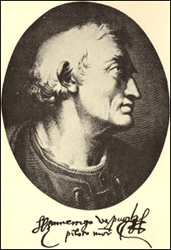
All the Cabot voyages of exploration were watched carefully by the agents of the Spanish Inquisition in England. Meticulous details of his previous voyages and the maps he made were sent to Spain....King Ferdinand and Queen Isabella put the Papal Bull into effect by issuing a license to kill to a notorious conquistador and cold-blooded murderer named Alonso de Hojeda . . . and sent him to intercept the Cabot expedition. On the Hojeda expedition was a navigator and mapmaker named Juan de la Cosa. Vital links References Barrara, Carlo Pezzi. Di Giovanni Cabotto. Tipografia Antonelli, Venezia, 1874. Hazlitt, Carew W. History of the Venetian Republic: Her Rise, Her Greatness, & Her Civilization (in 4 volumes). Smith, Elder & Co., London, 1860. Norwich, John Julius. A History of Venice. Random House, New York, 1989. Morison, Samuel Eliot. The European Discovery of America. The Northern Voyages, Oxford University Press, New York, 1971. Nebenzahl, Kenneth Maps from the Age of Discovery. Columbus to Mercator, Times Books Ltd, London, England, 1990. Pope Peter E. The Many Landfalls of John Cabot. University of Toronto Press. Toronto, 1997. Story, Joseph. Commentaries on the Constitution of the United States. Carolina Academic Press, Durham, North Carolina, 1987. (First published in 1833). Tarducci, Francesco. John & Sebastian Cabot. (Translated by Henry F. Brownson), H. F. Brownson Publisher, Detroit, 1893. The medallion of the New World Discoverer is from the book Di Giovanni Cabotto by Carlo Pezzi Barrera, Venezia, 1874. Copyright © 2013 by Patrick Scrivener
|